Agentic Workflows Explained: How Insights Work Moves Without Meetings
By Y2S Consulting, Yogi AI
- article
- AI
- Artificial Intelligence
- Innovation Research
- AI Agents
Summarise with AI


When people hear “agentic workflows”, the first reaction is often scepticism. Is it accurate? Who is checking the work? Should we trust it?
I want to reframe that conversation. Accuracy, verification, and trust are not “AI problems”. They are decision design problems. Our industry has always had issues with data quality, confidence, and governance. We debate fraud, statistical significance, and whether a result is strong enough to act on. The context is changing, but the underlying challenge is familiar: if nobody defines what a good decision looks like before the system starts running, you end up with confident errors at scale.
This article covers part of the webinar “From Insight Projects to Insight Systems: Decision-Driven Agentic Workflows”, which was part of The Next Generation Insights Summit held in April of 2026. Rewatch the entire webinar here:
From Insight Projects to Insight Systems: Decision-Driven Agentic Workflows
The demand for insight is going up, not down. I believe that is already happening, and it’s driven by three shifts.
First, the speed of decision-making is accelerating. Even with all the uncertainty we are dealing with, AI is making it faster to move from point A to point B. Therefore, decisions are being made more quickly.
Second, the volume of input is increasing. That has been true for over a decade, but the pace is rising again. Think about the data signals coming from connected devices, and the sheer volume of interactions now happening through AI tools. As such, the need for synthesis is going up as well. The problem is that it is overwhelming the system.
Third, human judgment is not going away. People worry about AI taking jobs or replacing humans. Take a breath. Human judgment is still essential, particularly to govern outputs. The work changes, but judgment remains central.
What I Mean by “Agentic Workflow”
Let’s start with the simplest setup: an LLM. You enter an instruction or a prompt, and it gives you an output. You might ask follow-up questions, but you are still driving the conversation.
Then we moved into the world of agents. Think about custom GPTs, Copilot agents, Gemini “gems”, or Claude “artefacts”. In these setups, an agent receives input, performs reasoning based on the instructions you have given, takes actions, evaluates, and hands off to the next step. That is why people use them for things like survey design, transcript analysis, or first drafts. These are useful, but they are still relatively discrete.
The agentic workflow is different. It is a string of multiple specialised agents working in sequence, almost like a cross-functional team, where work moves forward without you having to meet. Think of it as a dynamic system: a workflow built out from start to finish, with explicit handoffs between specialised roles.
At a high level, the structure is simple:
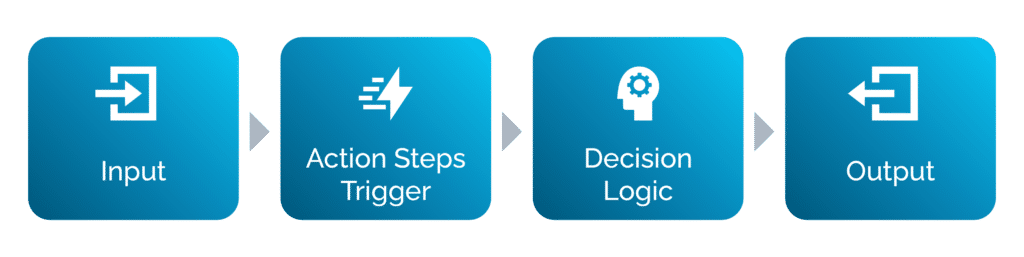
For insights work, the inputs might include primary research, secondary research, or other internal signals. The output might be something a brand team, an innovation team, or a leadership team uses to make decisions. The hard part, and the part we have historically under-invested in, is the decision logic in the middle.
Decision Logic is the Gap
When I say decision logic, I mean the “load-bearing” element of the workflow. If you have a stream of specialised agents working together, you need to make the logic explicit:
- Confidence thresholds: when is the output good enough to proceed?
- Escalation points: when does the system stop because it has hit an edge case and needs a human in the loop?
- Guardrails: when is the system never allowed to decide on its own, and when is it allowed to proceed?
- Trade-offs: how does the system weigh competing priorities?
We do these trade-offs in our heads all day, in meetings and on projects. What I am talking about is taking what we do implicitly and making it explicit so the system can operate the way we want it to.
Right now, most teams build agents, but nobody designs the decision logic. That is the gap. And I believe insights professionals have a big role to play here; maybe even an opportunity to own this space. If the inputs are coming from an insights perspective and the outputs enable action across the organisation, the people who design the decision logic become more influential, not less.
A Concrete Example: Concept Development as a Workflow
Let’s ground this in a workflow most people recognise. Imagine you are working on innovation and need to create brand concepts.
The typical process looks something like this:
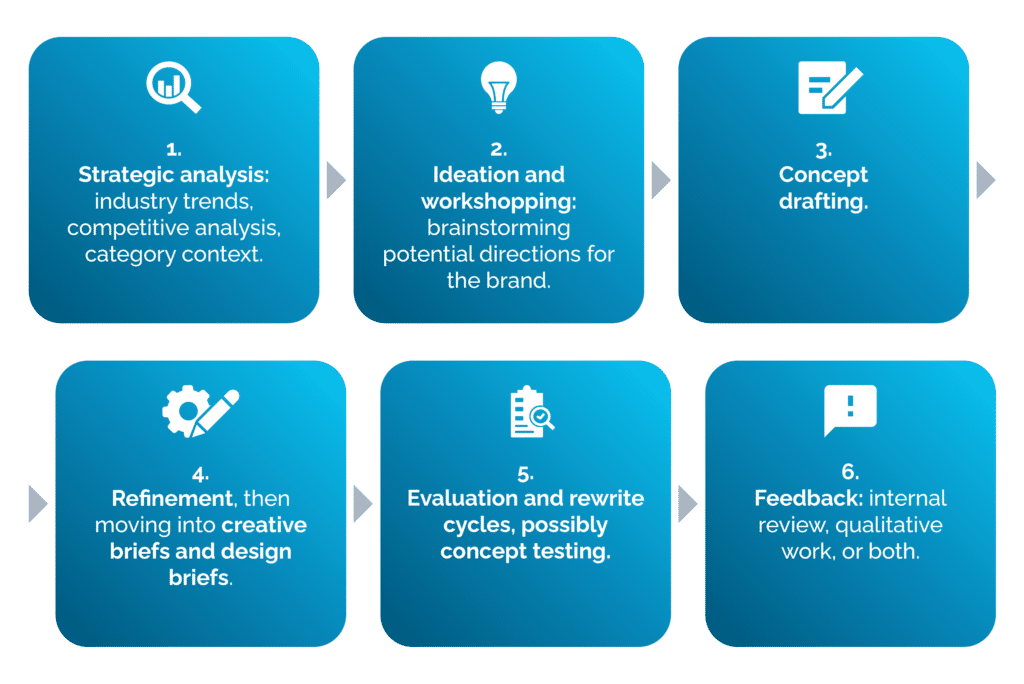
That is a workflow. It involves many people touching the work and waiting. Waiting for meetings, for feedback, for someone to come back from a trip, for schedules to align. The downtime is real.
Now imagine an agentic workflow where specialised agents do each stage in sequence, with explicit handoffs and decision logic that determines whether the output is good enough to move forward or needs escalation. You provide a small set of inputs at the start, and you get three refined concepts at the end. That does not mean there is no human work or no research. It means you are iterating differently, and faster, with less waiting.
The value is not just speed. It is in continuous operation, and the elimination of waiting that never added value in the first place.
What Can Go Wrong
Many things can go wrong. Hallucinations at scale are real, and implicit logic can break the system because the agent doesn’t know what to do with an edge case. If escalation is not designed properly, the workflow can continue running, and you only discover the problem at the end. New governance issues that you didn’t anticipate can also surface.
When I built my own workflow, all these things happened to me. The lesson is not “do not do it” but rather not to give up. Instead, you reframe the problem, find the root cause, and fix the decision design.
This is why governance is essential to efficiency, because without it, you just scale errors.
The New Job for Insights Teams
Traditionally, we spent a lot of time synthesising outputs and delivering recommendations, with expertise applied only after the work was done.
In an agentic world, the profile of the work changes. Your new job is to design the system by:
- Setting confidence thresholds
- Defining guardrails
- Designing escalation points
- Defining boundaries for what the system can and cannot decide
That is not something AI does for you. And because you must do it, this is where experience becomes more valuable, not less valuable.
What Skills Change, and What Do Not
People often ask what skills are missing. I actually think many of the skills are already in the profession; we just haven’t exercised them in this way.
To build a system, you need a plan. Start by being the architect and mapping the workflow as it exists today. Where are the flash points where things break down? Where does time disappear? Even when something went well, ask: what would have needed to be true for it to take 30% less time?
From a capability standpoint, I would highlight three areas:
- Critical thinking and problem-solving: the need for them is higher than ever.
- Collaboration and influence: stakeholders will have to give up control in some places, which is hard, but you need alignment around a different operating model.
- Leadership and vision: someone must define what “good” looks like, and make it explicit.
Also, don’t underestimate early-career colleagues. They see process gaps with fresh eyes. People who have been in an organisation for a long time can become blind to inefficiencies that are obvious to someone new. Both perspectives matter.
A Practical Starting Point
If you want to act quickly, here are three things you can do in a week.
- Write down your decision logic: look at the last five research projects you worked on. What counted as a good output versus a pass? What were the criteria, even if nobody wrote them down?
- Find the bottleneck you are still waiting for: where does work pause when the next meeting isn’t today but next week? Where are the lags?
- Decide on the ceiling before the floor: what will you never let the system do? What will you always retain as human judgment, versus what you are open to delegating?
If you capture those things, you have already moved forward significantly. The next frontier in insights is not faster research. It is the people who design the system.
This article covers part of the webinar “From Insight Projects to Insight Systems: Decision-Driven Agentic Workflows”, which was part of The Next Generation Insights Summit held in April of 2026. Rewatch the entire webinar here: