What Is an Intelligence-Native Organisation?
By Wortya
- article
- Synthetic Data
- Artificial Intelligence
- AI
- AI Agents
- Insight Transformation
Summarise with AI

This article is the first of the series Refactoring the Insights Industry by Adriana Rocha, drawing on lessons from her book Refactoring the Firm.
The Organisation That Never Sleeps
It is 3:40 in the morning. Nobody is in the office, and yet, inside the company, work is happening. A signal arrives from a market on the other side of the world: it’s a competitor’s price move, a shift in customer sentiment, an anomaly in this week’s sales data. The signal is captured, classified, and routed, creating scenarios to be simulated. A recommendation is drafted, with its reasoning attached and its confidence level declared. By the time the leadership team pours its first coffee, the decision is not waiting to be discovered, but waiting to be sanctioned.
No heroic analyst pulled an all-nighter to make this happen, nor was an agency briefed three weeks ago. The organisation itself did the work, because intelligence is not something this organisation buys, schedules, or commissions. It is something the organisation is.
That is an Intelligence-Native Organisation. And within the next three to five years, it will be your most attractive employer, most demanding client, most dangerous competitor, or often all three at once.
Why Hierarchies Can’t Get Us There
The organisational chart most companies still live in was not designed for this century. It was designed in the 1850s, when railroad companies needed to coordinate thousands of workers across vast distances with one communication technology available: the written order, moving at the speed of a train. The solution was borrowed from the military: a pyramid of command, where information flows up, decisions flow down, and every layer exists to compress, filter, and relay.
The pyramid organisational design was a masterpiece of industrial engineering. Control and stability were its features, but look at what it optimises for: departments, titles, reporting lines, fixed roles in fixed boxes. The pyramid assumes that the work of tomorrow will look like the work of yesterday, and that the scarcest resource will always be coordination.
Then intelligence became abundant: analysis that took a research team three weeks happens in minutes. Signals that once required a quarterly tracker arrive continuously. AI agents can monitor, synthesise, simulate, and draft around the clock, and suddenly the pyramid’s greatest strength, its stable, layered filtering of information, became its fatal flaw. Every layer that once added order now adds latency. Every human router who once compressed information now bottlenecks it, and in a world where intelligence moves at machine speed, the organisation that moves at meeting speed loses.
I did not learn this from a whiteboard. I learned it living inside hierarchies during my entire corporate life, from three hundred people to thirty thousand people, across three continents, and then again, more recently, painfully, as a founder. Building a new venture ecosystem, I found myself the mid-node of every decision: routing information across time zones, translating between teams, approving things at midnight. I had built companies designed around intelligence, and I was still the bottleneck. That experience is what forced me to stop patching the pyramid and start refactoring the firm.
The Definition
An Intelligence-Native Organisation (INO) is an organisation designed so that intelligence, human and artificial, is the primary coordination mechanism, flowing continuously through a fluid mesh of people and AI agents, governed by explicit rules, where systems propose, and humans sanction.
There are four ideas here that matter, and they are easier to understand if we look at what actually changes inside the organisation:
1. Designed, from the beginning.
The first distinction is probably the most important: being intelligence-native is something you design into the organisation. You don’t become one simply by adopting more AI tools. An INO is architected from first principles around the assumption that intelligence is abundant, continuous, and shared between humans and machines. The difference is the same as between a company with a website and one born digital: one bolted the new capability on while the other is made of it.
2. Structured around verbs, not nouns.
The second shift is harder to see because it changes something very basic: how we think about work. Traditional organisations are built around nouns – Marketing, Insights, Research, Finance… In an intelligence-native organisation, work itself is made of verbs: sensing, interpreting, testing, deciding, acting, and those verbs matter more than the boxes on the org chart.
Work is not assigned down a chain; it flows through the organisation, finding the people and agents best suited to it at that moment. Teams form around outcomes, deliver, and dissolve. The org chart stops being a map of power and becomes what it always should have been: a snapshot of current flow.
3. A living mesh with three zones.
Picture the INO as a neural mesh with three concentric zones:
1) At the centre sits the company’s brain and a stability core: the organisation’s constitution, purpose, and non-negotiable principles – the part that deliberately does not move fast.
2) Around it operates a dynamic execution mesh, where hybrid teams of humans and AI agents form, work, and dissolve as outcomes demand.
3) At the boundary lies a permeable edge, where partners, customers, freelancers, and yes, agencies, plug directly into the organisation’s intelligence flows rather than lobbing PDFs over the wall.
Stability at the core, fluidity in the middle, openness at the edge.
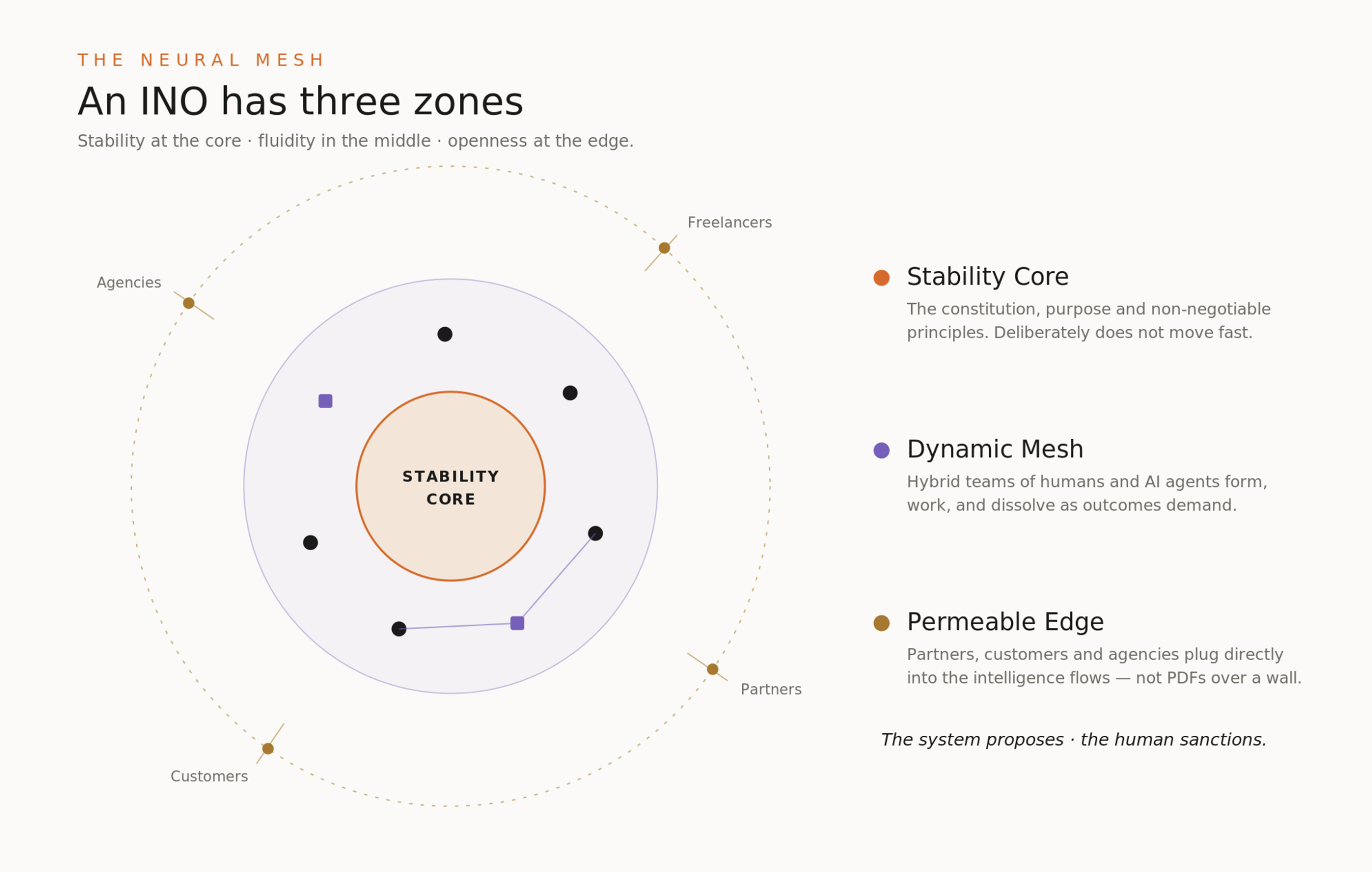
The neural mesh
4. Agents as governed participants, with humans in charge of meaning.
This is perhaps the part people misunderstand most. I don’t see AI agents as smarter tools sitting on someone’s desktop. In an intelligence-native organisation, they become part of how the work gets done: they can have roles, boundaries, responsibilities and audit trails, but there is still a line I don’t want to cross: the system can propose, but humans remain responsible for what the organisation means, values and ultimately decides.
Agent “citizenship” is conditional, and the condition is constitutional: the system proposes, and the human sanctions. No consequential decision ships without human approval, as I put it in the book: agents handle the signal, humans handle the meaning. The point of the INO is not to remove humans from the loop, but to remove humans from the routing so they can finally focus on the reasoning.
What an INO is Not
A company can use AI everywhere and still be fundamentally organised in the old way. That is not an intelligence-native organisation; it is the same organisation with better tools.
An INO is not “a company that uses AI”. Most companies today are running pilots inside unchanged structures – the pyramid with a chatbot. Adoption without redesign produces faster emails, not faster organisations.
An INO is not full automation. Synthetic intelligence is superb at signal: monitoring, synthesising, simulating, drafting. It is not the arbiter of meaning: judgement, values, accountability, the decision of what the organisation should want. An INO amplifies human judgement; it does not abolish it.
An INO is not chaos with extra software. The INO is, if anything, more explicitly governed than the traditional firm: its rules, boundaries, and decision rights are written down, machine-readable, and enforced – not implied by whoever has the corner office. The freedom of the mesh is earned by the rigour of the core.
Why This Matters to You on Both Sides of the Table
If you lead an insights team inside a brand, the INO describes your next decade. Insights teams will evolve into something far more central to the organisation’s strategic decision-making: the customer and market intelligence core of the organisational brain, curating continuous flows, running simulations, activating data assets, and safeguarding the questions machines cannot answer – the whys behind human behaviour. To me, this is the biggest promotion the insights function has ever been offered, but it has to be claimed, not awaited.
If you lead an agency, the INO describes your next client. When client organisations run on continuous intelligence, the report and deck won’t disappear, but they will stop being the thing the client is really buying. When intelligence becomes continuous, the value moves from the deliverable to the expertise behind it, and to how deeply that expertise becomes part of the client’s own intelligence system.
Clients will expect your expertise to plug in: your data assets accessible to their systems, your specialist knowledge available as continuous intelligence, your consultants embedded in their transformation. The agencies that thrive will not be the ones defending episodic delivery; they will be the ones who become partners in their clients’ evolution, including helping them become INOs.
Neither transformation starts with a big AI programme. It starts much closer to home: with the people who have to learn to work differently.
Where this Series Goes Next
This is the beginning of a conversation about what it actually means to become intelligence-native, and I want to explore it from the inside out, because before we refactor the organisation, we have to refactor the people working in it. Before an Insights function can become an intelligence core, the people inside it need to understand what AI can do, what it cannot do, and, perhaps more importantly, what remains uniquely human.
So in the next article, “Refactoring Your Skillset for the Intelligence-Native Era”, I’ll move from the organisation to the individual. What does it mean to become genuinely useful in a world where machines can already analyse, synthesise, simulate and draft? What do we need to learn? What should we stop doing? And how do we build the credibility to lead when the rules of expertise themselves are changing?
From there, we’ll move outward: to leadership, to the Insights function, and finally to the agencies and partners that will have to evolve alongside their clients.
The pyramid served us well for a very long time, and I don’t think its retirement means we throw away everything we learned from it. It means we stop asking the old structure to solve a problem it was never designed for.
The next chapter of the Insights industry won’t be about who has the most AI tools. It will be about who knows how to organise intelligence, both human and artificial, into something that can actually move. And that transformation starts with each of us.