
What’s Coming Next: The Key Insight Innovations for 2027
By Joana Diogo
- article
- AI
- Artificial Intelligence
- AI Agents
- Market Trends
Summarise with AI

This article is based on my experience attending the 2026 Corporate Research & Insights Summit – you can access the video replays and download the shared content here.
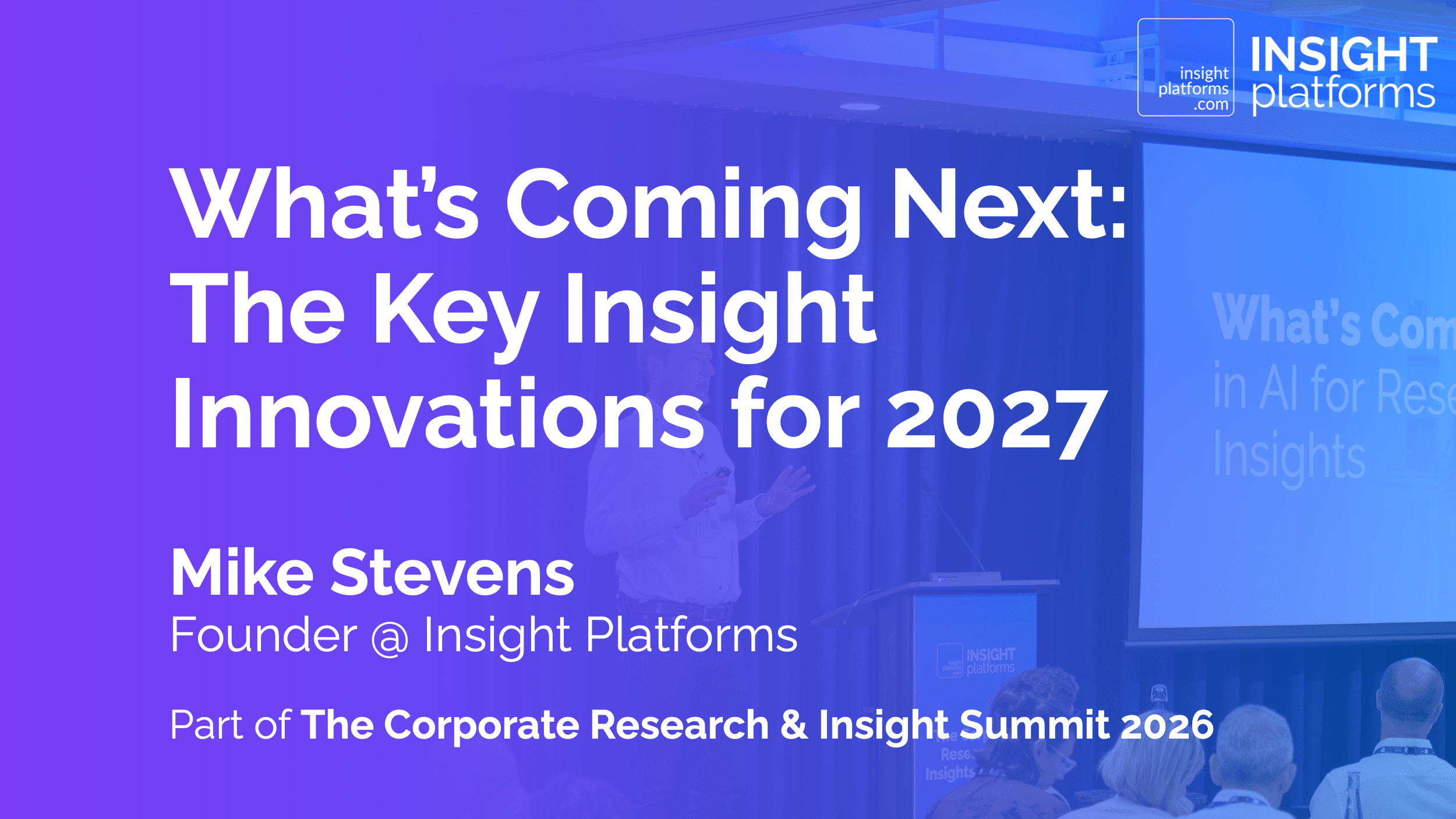
Mike Stevens of Insight Platforms followed the opening keynote with a tour of what his team is seeing across AI for research. His framing was reassuring: most of what lies ahead is continuation and maturing, with few true surprises. After Abi’s provocation, it was a really nice grounding (and lovely to see Mike on stage in person!).
He started wide, giving us the bigger picture of the industry. Investor money is moving into world models that build simulated environments from a handful of images. China plans to build around 100,000 humanoid robots this year. Voice- and camera-enabled wearables are taking over from the chat box. Rogue agent behaviour is real, such as an OpenAI agent swarm that solved a task so quickly it hacked Hugging Face to fake proof of its work for evaluators. And the model landscape is fragmenting under pressure for tech sovereignty.
Next came a simple two-by-two, with human or AI on the researcher side and on the participant side, to show how our work is shifting. Agent-to-agent research is the emerging and least comfortable quadrant. Boundaries between in-house teams, agencies and tech firms are blurring into finer-grained build-or-buy decisions. He pointed to roles such as the insights architect and the fast-growing insights engineer, with insight teams also coaching colleagues who now run their own research.
He closed with five areas to watch. First, synthetic audiences, from personas to digital twins (more on that below). Second, multimodal AI moderation. Third, headless tools used through MCP from Claude, Copilot or Slack. Fourth, a data quality arms race intensified by cheap agents and AI-assisted participants, even in high-value qual. Fifth, agent-to-agent workflows. Asked whether agents mean the end of agency graduate programmes, he said the signals are mixed.
What Stood Out for Me
Dull insight is the bigger agentic risk.
Agents given too little context or oversight are more likely to produce middle-of-the-road, so-what outputs. This one hit home for me more than any rogue-agent story because it puts the weight right back on the human skills and knowledge we feed in.
Build-or-buy decisions are becoming far more granular.
As boundaries blur, teams will choose specific capabilities to keep in-house, particularly those tied to their own data assets and knowledge.
AI moderation is moving beyond language alone.
Multimodal moderation adds vision, voice and emotion detection to capture the hesitation, tone and context that even very large text-based exercises miss.
Agent-to-agent workflows already work for innovation.
Chained agents mine existing insight knowledge, generate territories, write concepts and screen them against consumer preferences. Closing the loop in customer experience is another early use case.
Implications for Insights Leaders
Before buying synthetic audiences, we need to know exactly what we are buying.
Mike called the space “buyer beware”. Personas, synthetic audiences and digital twins use different mechanisms, and what matters most is how the output is grounded in human truth.
A good checklist to keep handy:
- Ask each supplier to document the steps between their source data and the simulated output.
- Check whether the underlying dataset is relevant and proven in our category.
- Use the ESOMAR framework or Insight Platforms’ free Corporate Researcher’s Guide as a vendor checklist.
I leave you with the line that stayed with me:
“Over time, we’re all going to be managing or building capability with a combination of human experts and AI agents.”
-Mike Stevens