
AI for Insights: The Good, The Bad & The Ugly
By Joana Diogo
- article
- AI
- Artificial Intelligence
- AI Agents
- Synthetic Data
- Survey Analysis
Summarise with AI
This article is based on my experience attending the 2026 Corporate Research & Insights Summit – you can access the video replays and download the shared content here.
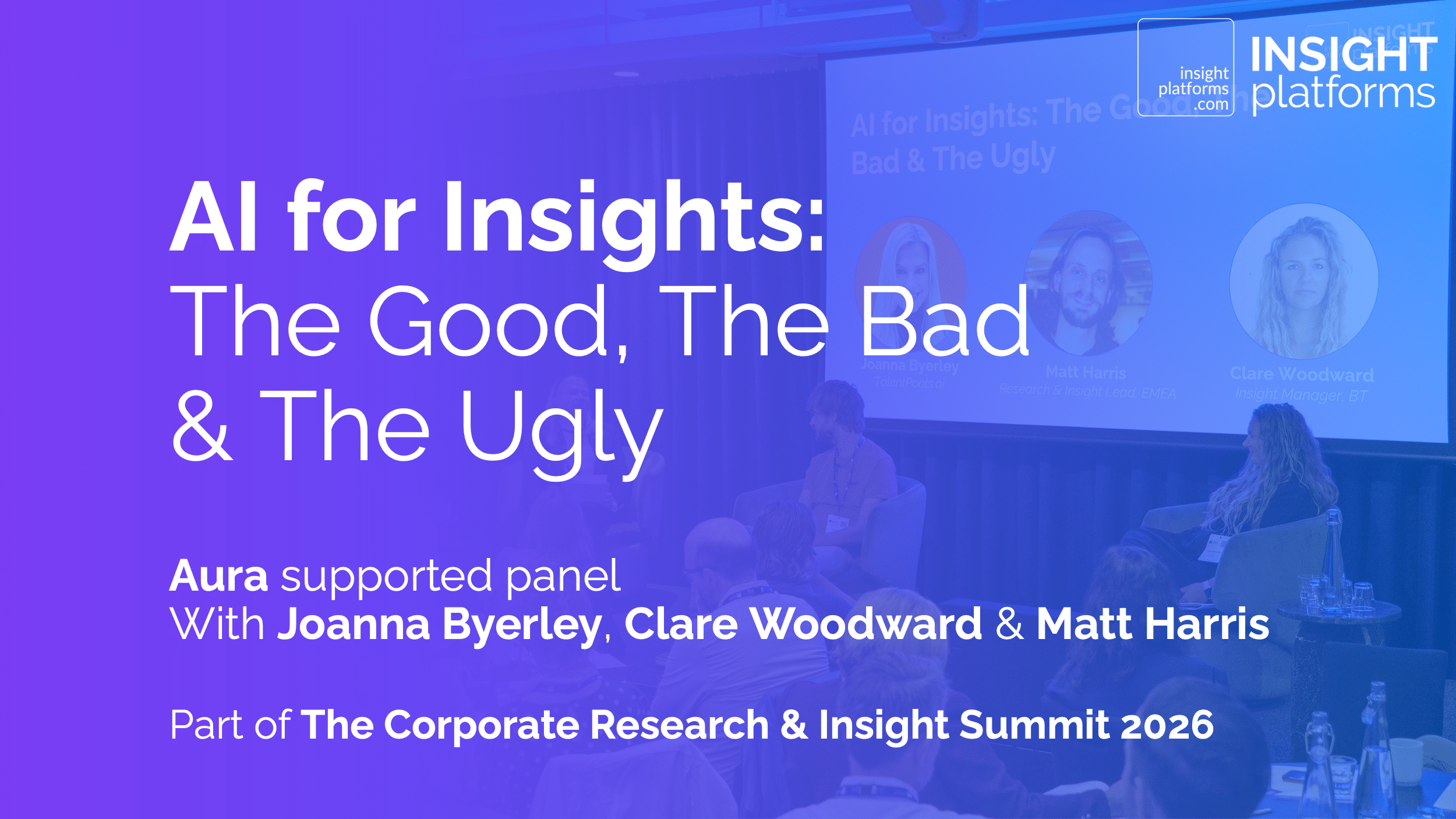
The first panel of the day, supported by Aura, brought together Clare Woodward, Insight Manager at BT and author of the MRS best practice guidelines on AI for client-side teams, and Matt Harris, Research & Insight Lead, Europe at Canva, with Joanna Byerley of Talent Pools.ai moderating. Joanna noted that recent warnings from Anthropic’s Dario Amodei had the “ugly” well covered, and steered us towards what is working, what is still in progress and what it all means. She also let slip that her panellists had disagreed on plenty during their prep call (which made for a really lively half hour!).
For Matt, AI moderation has cut simple concept feedback from two or three days to two or three hours, bringing research into moments it previously missed, and agentic survey analysis has turned crosstab pulling into a conversation with the data. Clare was more excited by what was previously impossible: always-on competitor analysis, locally attuned tools for global studies, and using AI to assess how AI recommendations affect brand consideration.
Both saw synthetic research as work in progress (more on that below). Matt argued for leaning toward giving stakeholders access and starting with a single project ahead of any long RFP, since products move on within months.
On value and talent, Clare warned that AI could take the seat at the table insight teams have long asked for, and that with fewer juniors coming in, fewer people will learn what good looks like. Matt estimated that Canva’s global team would need to be two to three times its current size to do the same work by hand. Joanna described the talent pipeline as a pyramid that collapses once its base is gone. That image stuck with me.
What Stood Out for Me
Survey analysis becomes a conversation with data.
Agentic analysis allowed Canva to consolidate five or six surveys across 10 markets in three weeks. With the right harness, Matt said, frontier models go further than commercial research software currently does.
Synthetic behaves like pooled expert common sense.
Matt compared it to 100 researchers and marketers giving common-sense judgements: useful, and still unfinished. Models tuned for coding and maths may struggle to represent diverse perspectives.
Know what your synthetic data is built on.
Clare’s concern was data control: what models are trained on, and how new answers dilute the original data, especially once access is democratised with loose controls.
Use AI with intent.
The BEST Framework asks where AI adds value and includes questions for suppliers on training data, access and what feeds back in. Definitely one to bookmark.
Implications for Insights Leaders
Our stakeholders may soon go straight to AI for insight.
Sceptical stakeholders given AI tools may have little reason to return. We need to show where our judgement, validation and interpretation still shape the answer. Clare’s point felt like a wake-up call. A few ways to act on it:
- Record where we added value on our last three AI-assisted projects and share it with stakeholders.
- Agree on a working definition of insight versus information and use it consistently.
- Name the internal advocates for insight and brief them on our role in AI-driven work.
The line that stayed with me:
“Anyone in this room using synthetic data, using personas, using digital twins, really interrogate what the data it’s based on is because that will cause you all sorts of problems if you don’t know the answer.”
-Clare Woodward