
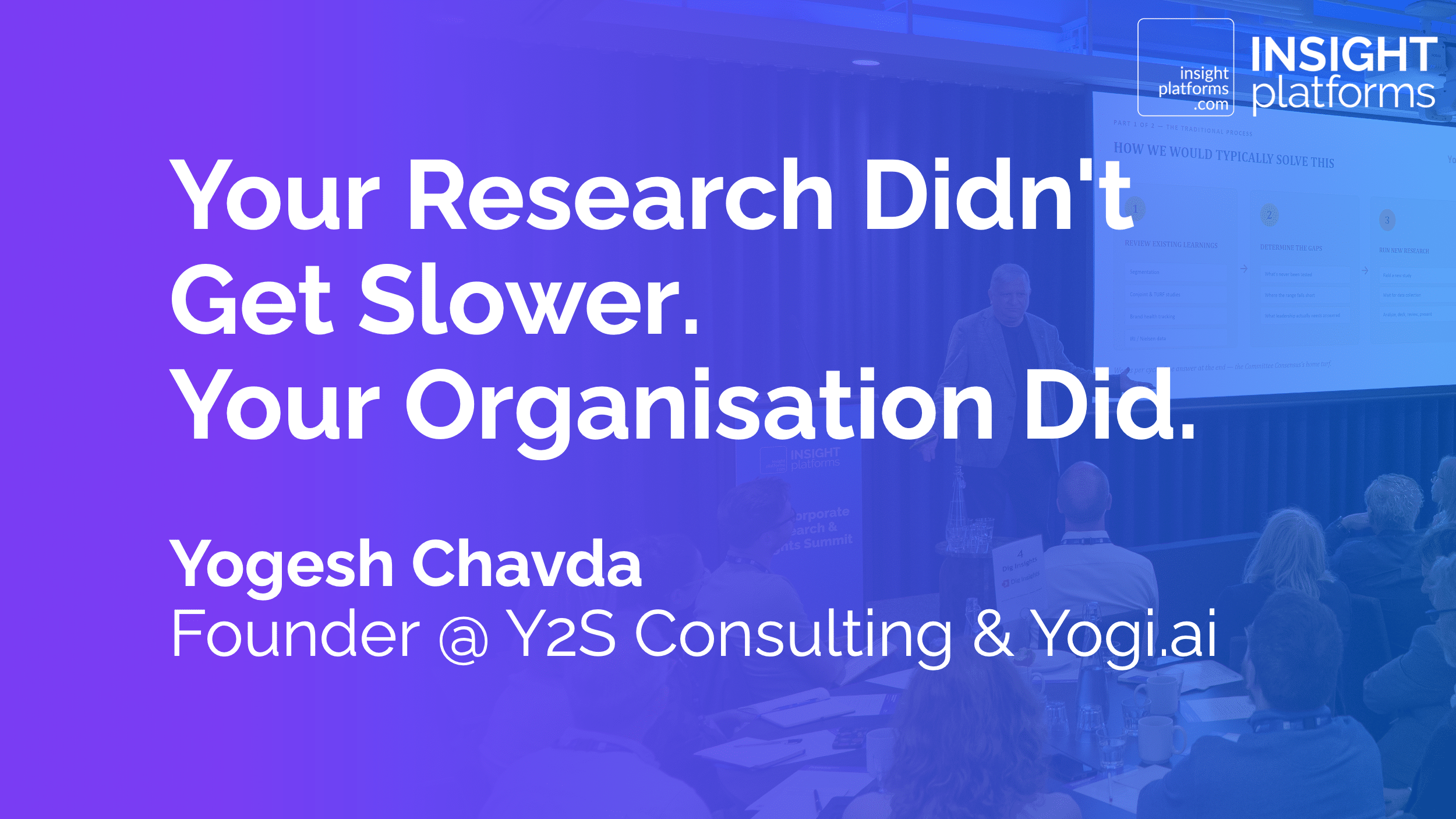
Your Research Didn’t Get Slower. Your Organisation Did.
By Joana Diogo
- article
- AI
- Artificial Intelligence
- Data Analytics
- Advanced Statistical Techniques
- Survey Research
- Agile Quantitative Research
Summarise with AI
This article is based on my experience attending the 2026 Corporate Research & Insights Summit – you can access the video replays and download the shared content here.
Yogesh Chavda of Y2S Consulting and Yogi.ai drew on 30 years on the corporate side to argue that insight value means decisions that grow revenue and profit, and that the real drag on research is organisational behaviour. His villain was committee consensus. Anyone who has sat through a few too many meetings will know this villain!
He walked us through a real CPG case from earlier this year. A brand had lost distribution, stopped investing, faced rising input costs and retailer demands for category growth, and had two years to wait for its next innovation. Finance wanted a 70% price increase, far beyond what a two-year-old conjoint study had tested, and a new study was beyond the budget.
Acting as architect, Yogesh built an agentic system on Claude from existing conjoint, TURF, segmentation, and tracking data, including a scenario engine, an equity investment model, a war game simulator, and a convergence check. He framed it as a thinking tool for sequencing choices, deliberately distinct from a prediction. The team settled on a contested recovery scenario after a couple of weeks, with all four scenarios still switchable, and he gave them a secure link to run the model themselves.
He offered four questions for deciding whether agentic belongs:
- Is it repeatable?
- Are there multiple variables?
- Are the inputs available?
- Who owns the decision?
His answer to the last was people.
In Q&A, he said similar systems can be built in Copilot Studio, urged experienced researchers to act as masters to junior apprentices, and called for redesigned workflows and clear swim lanes as marketers build their own agents.
What Stood Out for Me
Committee consensus slows research more than methods do.
Supply chain, finance, sales, and marketing rarely agreed, so the brand spent weeks in meetings. Yogesh sees organisational behaviour as the real bottleneck.
Insight value means a direct line to revenue.
Yogesh measures value by decisions that grow revenue or profit, and sees AI as a fresh chance for insight teams to build that direct line.
Build thinking tools over prediction engines.
Predicting the effect of a 70% price rise within 10% is beyond anyone. His system showed what happens when assumptions change and how confident each assumption is. His simple move from tested to extended to synthetic ranges felt like the most practical answer to the synthetic data debate I heard all day.
Synthetic data works best when it extends existing evidence.
He used it to push conjoint and TURF curves to plus 70% and plus 150%, respectively, and argued that framing synthetic as a replacement keeps the debate too narrow.
Implications for Insights Leaders
Insight that stops short of a revenue decision leaves us exposed.
As AI takes over routine work, findings on their own will carry less weight. He ended on the idea that judgement is what the insights industry is really about, a good reminder in this AI and speed era we’re facing, and it reinforced for me the importance of what we do every day.
Here’s how to put that into practice:
- List your top three current projects and name the commercial decision each will inform.
- Bring a finance partner into scoping for the next pricing or investment question.
- Report project outcomes in revenue or P&L terms alongside the findings.
I leave you with the line that stayed with me:
“My career has been based on the premise that I’m a business person with an insights background. We are paid to provide business judgement. That’s how we become valuable to the organisation.”
–Yogesh Chavda