
Changing Behaviour by Understanding Beliefs
By Chris Harvey
- article
- Behavioural Insights
- Behavioural Science
- Behavioural Research
Summarise with AI



This article covers part of the webinar “Beliefs Beat Attitudes: A Smarter Route to Consumer Behaviour Change”, which was part of The Next Generation Insights Summit held in April of 2026. Rewatch the entire webinar here:
Beliefs Beat Attitudes: A Smarter Route to Consumer Behaviour Change
I believe there’s a smarter route to consumer behaviour change and its based on a simple idea that when our objective is to change what people do, we are better off exploring their beliefs than exploring their attitudes.
To explore that idea, I’ll cover three things in this article:
- Defining beliefs and attitudes, and illustrating how many of them each of us holds.
- Introducing a practical framework for exploring beliefs by looking at three recognised types.
- A short action plan to help you put the approach into practice.
Beliefs and Attitudes Are Different Things
A straightforward way to separate these two concepts is:
- A belief is what people think.
- An attitude is what people feel.
To make that real, imagine we are doing research into electric cars. One statement someone might agree with is: “Electric cars produce fewer emissions than petrol cars”. That is a belief as it expresses what someone thinks is true or false.
Now consider a different statement: “I feel excited about driving an electric car”. That is not what someone thinks. It is what someone feels, so it is best described as an attitude.
Beliefs and attitudes can be useful because they help us explore and distinguish between both what people think and what they feel.
We Hold Thousands of Attitudes and Even More Beliefs
Most adults hold thousands of different attitudes. That is, thousands of different things they have feelings about. Beliefs are even more numerous as the average adult holds tens of thousands of beliefs, and in some cases hundreds of thousands.
Given those numbers, it is simply not realistic to cover every belief or attitude in a piece of research. We often face constraints on time and budget, so the key question becomes: Where should we focus our efforts?
If You Want to Change Behaviour, Start with Beliefs
This is the most important point. If the objective is to change consumer behaviour, the evidence suggests we need to focus on consumer beliefs more than attitudes.
One way to see this is to look at how behaviour change is modelled. Below is a typical representation of how behaviour change arises from a mass media campaign.
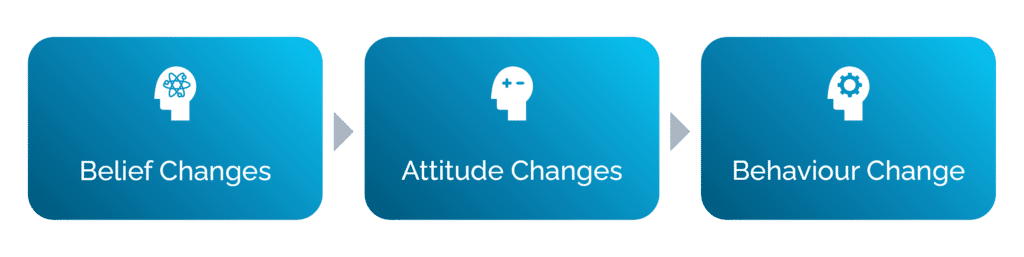
While changes in attitudes are a critical outcome on the way to behaviour change, what typically comes before changes in attitude are changes in beliefs. In other words, if we want to change what people feel about something, we first need to change what they think about it.
The next question is obvious. If people hold tens of thousands of beliefs, where do we begin?
A Practical Framework for Exploring Beliefs
I use a simple but long-established academic framework that separates beliefs into three types that reveal consumer commitment to behaviour and help us avoid costly mistakes when interpreting data about beliefs.
The three belief types are:
- Descriptive beliefs
- Evaluative beliefs
- Prescriptive beliefs
Each type has a different relationship with likely behaviour.
1. Descriptive beliefs
A descriptive belief is what people think is true or false. In the electric cars example, the statement, “Electric cars produce fewer emissions than petrol cars”, is descriptive. It expresses a perception of truth.
Descriptive beliefs typically represent cognitive recognition. They can be useful, particularly in situations such as a new product release, where you want to understand what people think is true about your product or the marketplace.
However, descriptive beliefs typically do not correlate strongly with intentions to behave in a certain way as people can recognise facts or claims without acting on them.
2. Evaluative beliefs
An evaluative belief concerns what people consider good or bad. An example might be, “Owning an electric car is a good way to reduce my carbon footprint”. Notice how this differs from a descriptive belief about what is true. Evaluative beliefs add judgment.
Agreement with an evaluative statement indicates greater commitment than agreement with a descriptive belief. When someone says something is good or bad, they are taking a position, not just recognising a claim.
Even so, evaluative beliefs can be mistaken for intention to act. Someone can express a positive judgment without having any real intention to follow through. Evaluative beliefs carry more weight than descriptive beliefs, but may still be far from a green light when it comes to predicting behaviour.
3. Prescriptive beliefs
A prescriptive belief is about what people think is desirable or undesirable. In the electric cars example, a prescriptive belief might be, “I should switch to an electric car to protect the environment”.
Out of the three types of belief, prescriptive usually indicates the greatest intention to behave in a certain way. That said, we still need to be careful. When someone says they should do something, it can mean different things. It may reflect what someone thinks society expects them to do. Or, it may reflect a longer-term aspiration rather than a short-term goal.
However, even with those caveats, prescriptive beliefs usually indicate stronger behavioural commitment than the other two types.
Framework Action Plan
If you’d like to apply belief types in your research, below are four concluding tips.
1. Choose projects where beliefs are especially important
This framework works well in several types of research projects.
Brand tracking and campaign evaluation are the strongest candidates. If you build a good mix of beliefs into your metrics, you get a clearer view of likely behaviour as a result of exposure to your brand or campaign. The key is to cover a broad range of descriptive, evaluative, and prescriptive beliefs rather than leaning heavily on one type.
The same principle applies in other projects, including new product testing research and research to understand consumer decision-making in a category.
2. Avoid overlapping statements
In the design phase, be careful not to create overlapping belief statements. Each belief statement should fit into one and only one of the belief types described above.
This can be deceptively tricky as it’is easy to write a statement that contains elements of truth, judgment, and desirability all at once. When that happens, you lose the ability to interpret what agreement really means.
3. Do not mistake volume for importance
In the analysis phase, you may see agreement with lots of different belief statements but don’t assume that volume implies importance.
If, for example, many of the high agreement statements are descriptive, you may feel or convey a misplaced sense of confidence in likely behaviour. Descriptive agreement can feel reassuring, but it does not necessarily signal behavioural commitment.
4. Remember beliefs are not everything
Finally, beliefs and attitudes both matter. However, many other factors can also affect behaviour.
For example, habits, incentives, impulses, and social influences are just a few things that can also have a very big impact. The belief types framework helps you interpret beliefs more accurately, but it does not remove the need to consider other drivers.
Next Steps
This thinking underpins a new training course I’ve developed, combining behavioural models and AI to strengthen insight generation and decision-making. Explore it here.
This article covers part of the webinar “Beliefs Beat Attitudes: A Smarter Route to Consumer Behaviour Change”, which was part of The Next Generation Insights Summit held in April of 2026. Rewatch the entire webinar here: