From Gatekeeper to Door Opener: How AI is Changing the Role of the Enterprise Insights Team
By Toluna
- article
- Agile Qualitative Research
- AI
- Artificial Intelligence
- AI Personas
- Survey Research
- Customer Panels
- Insight Communities
- Long Term Communities
- Qual-Quant Hybrid
- Survey Panel
- Synthetic Data
Summarise with AI




For as long as I have been in this industry, the research function inside enterprise organisations has operated in a particular way. A specialist team manages external research partners. That team translates business questions into research programmes, interprets the findings, and passes the results to internal stakeholders. It is a structure built around expertise and, inevitably, around control.
AI is going to change that structure. I do not think this is a distant possibility – it is already beginning. The question is not whether it will happen, but how the research function responds to it.
Learn more by watching or listening to Frédéric-Charles Petit on the Founders and Leaders Series podcast here:
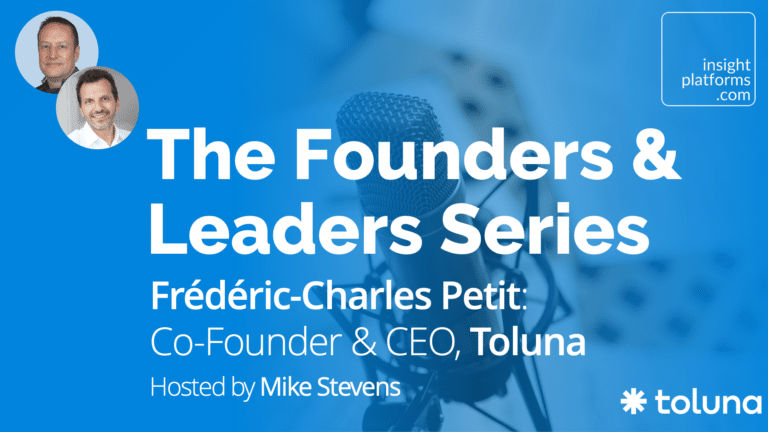
Episode 10: Frédéric-Charles Petit, Founder & CEO, Toluna
The Industry Itself Will Be Disrupted First
Before we talk about what happens inside client organisations, it is worth being clear about something: the research companies themselves are the first to face disruption. If you want to truly scale AI and deliver AI-powered insight, you need to change the way you work. That requires significant internal change in processes, systems, and how teams are organised.
This is not a challenge that sits only on the client side. It sits with every organisation in this industry. I say that not as a concern, but as a statement of fact about where the work needs to happen.
The Insight Function at a Crossroads
For client-side teams, I believe the change in the insight function is real, but I want to be precise about what kind of change I mean. I am not describing the decline of the function. I think it is, in fact, a reinforcement – provided the function does not retreat into what I would call the legacy stage gate model.
The stage gate model is familiar. Research sits at certain defined points in the decision-making process. A project cannot move forward until it has passed through the research function. The team controls when and how consumer insight enters the conversation. That model was not designed to be obstructive. It was designed to ensure rigour. But in a world where AI is generating content, campaigns, and product variants at a speed that research has never had to keep pace with before, a stage gate becomes a bottleneck.
The alternative – and this is what I see with clients who are moving forward – is for the research function to become a door opener. Rather than being the point through which all research must pass, it becomes the function that opens access to consumer insight across the organisation. It sets the standards, ensures quality, and enables others to use research as a tool in their own planning and decision-making.
The research function has always been, at its best, a door opener. AI is now creating the conditions for it to fulfil that role more fully.
The Democratisation Question
Democratising research has long been an ambition in this industry. I have been thinking about it for twenty-five years. The honest assessment is that we have made partial progress at each stage.
Online research and DIY platforms delivered some democratisation. But research has remained, in many enterprise organisations, largely confined to a specific function and a specific set of users. The tools have been accessible in theory. In practice, the expertise required to use them well has limited their spread.
I see AI as the mechanism that can genuinely and at scale change this. Not just in the sense of making research faster, but in the sense of making it usable by people who are not researchers. Someone working in marketing, product development, or a regional business unit has business questions that consumer insight could help them answer. The barrier has not been their interest in the answer. It has been the complexity of the process required to get there.
AI, properly built and backed by high-quality data, can significantly reduce that barrier. More people within an enterprise can use research with more confidence. They can apply it as a decision-making tool within their own area of the business. That is what democratisation within the enterprise actually looks like.
The Speed Problem
There is a specific dimension to this that I think is worth stating clearly, because it changes the practical urgency of the issue.
AI is creating an explosion of content – an explosion of variation. More campaigns, more claims, more product concepts, and more creative executions are being generated than ever before. If you rely on traditional research methodology, you are not going to be capable of testing all of that content or delivering research and insight at the speed at which AI is producing material that needs to be validated.
The only way to match the speed of AI-generated content is to use AI in the research process. That is not an argument for replacing high-quality human data. It is an argument for using AI to do more with it, faster. Strong data and high-quality respondents remain essential. But the way they are used and the way their value is extracted and applied have to change.
What Truth is Worth
I want to make one broader point, because I think it is underestimated within the industry.
We are in a period where truth is genuinely difficult to establish. That challenge spans many domains and affects the context in which decisions are made. The research industry – an industry built on first-party data, grounded in truth, designed to produce reliable information about what people actually think and do – has a significant and distinctive value in that environment.
The outputs of our research are used to make important decisions. Decisions about products, marketing, and how brands understand and respond to their markets. The rigour and integrity of that process matter.
I think this value is sometimes taken for granted within the industry, and it shouldn’t be. At a time when reliable information is harder to come by, the ability to produce it – with strong methodology, verified data, and clear accountability for quality – is the foundation on which everything else in this industry is built.
The Practical Implication
For insights teams inside enterprise organisations, the question that AI raises is not primarily about technology. It is about the role.
A team that defines its value by controlling access to research will struggle as AI makes research more accessible. A team that defines its value by the quality of the insight it enables – regardless of who, in the end, runs the study or reads the output – is well positioned for what is coming.
The shift from gatekeeper to door opener is not a loss of relevance; it is a change in how relevance is expressed. The research function can know the consumer pulse at the speed of AI and give that access to the whole organisation. That is a larger role, not a smaller one.
Learn more by watching or listening to Frédéric-Charles Petit on the Founders and Leaders Series podcast here: