
How Not to Use AI for Insights
By Joana Diogo
- article
- AI
- Artificial Intelligence
- AI Agents
Summarise with AI


This article is based on my experience attending the 2026 Corporate Research & Insights Summit – you can access the video replays and download the shared content here.
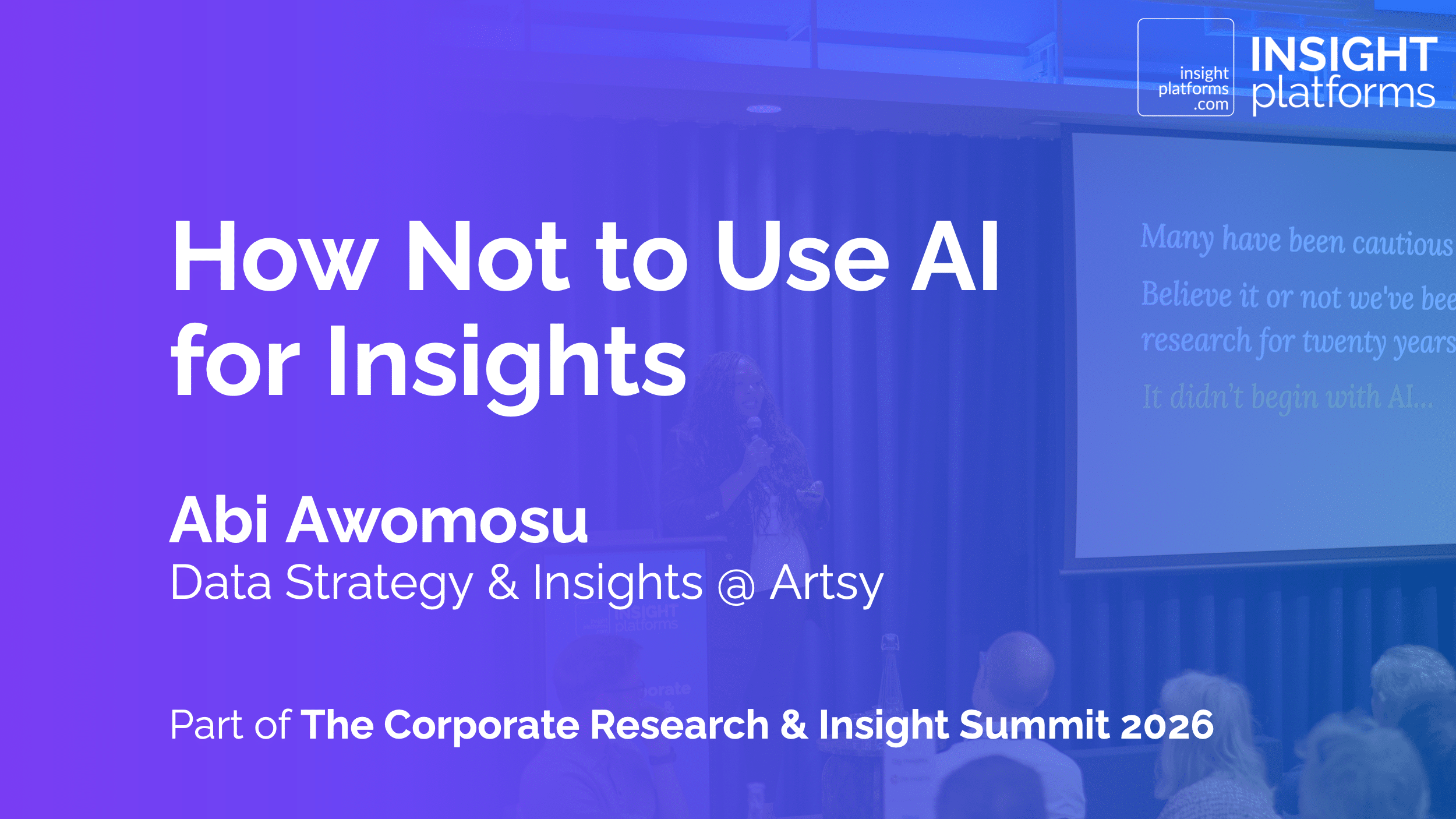
The Corporate Research & Insights Summit opened with Abi Awomosu, and she set aside the usual talk of models and workflows to ask a bigger question: what would happen if researchers stopped following the Silicon Valley playbook for AI? She described the dominant story, that AI will take your job, replace you, and eventually kill you, as one imagined by a small group of people in one small part of California. Her message to the room was clear: the direction of AI is ours to shape too, and we can leave the tech bros out of the driving seat. What a way to kick off the first edition!
Drawing on 20 years working with data at IBM, Apple, Uber and Meta, she presented AI as an accelerant of habits our industry already had. Her first job, documenting a team’s work so it could be outsourced to India, was an early version of today’s agents. Uber’s dashboards gave a “God complex” view of drivers yet missed the welfare issues behind its scandals and lost licence. She traced familiar methods to their origins: the census to population control and taxation, focus groups to wartime propaganda. Because those methods shape how algorithms are trained, their assumptions carry through. This one really stuck with me (uncomfortable in a good way), because so many of these methods sit at the heart of what we do every day.
Her alternative to the linear path, where the only question left is how fast, was a spiral, like the staircase in the LSE library. She described LLMs as “large listening mediums” that have mapped human meaning, and proposed her billion-person focus group, drawing on the Latin root of focus as hearth. With it, she said, she saw people using AI as a creative partner and emotional support a year before Anthropic published its own large-scale study of how people use AI.
She closed with seven shifts for corporate researchers, from treating AI as a medium to arranging agents as a village.
What Stood Out for Me
Factory architectures produce uniformity.
Abi arranges agents as a village instead, with guardians screening data ethics and ethnographer agents reading context, each checking the others. What a refreshing way to picture agentic workflows.
Business language narrows the model’s possibility space.
Terms like “penetrate markets” and “target demographics” carry a war footing into prompts. Open questions, or what she calls prompt poetry, such as asking what the data is screaming, return wider answers. I’m definitely trying this one out!
Commission agents the way you would commission an architect.
Set guardrails and a vision and leave the execution open. Role-based play flows allow for the variance that assembly-line workflows suppress.
Treat AI as a medium.
A hammer leaves its user unchanged, while AI changes how you think. Abi sees researchers as mediators between its knowledge and evidence, context and rigour.
Implications for Insights Leaders
Our inherited methods carry assumptions that AI tools will scale.
Census, focus groups, sentiment analysis and psychometrics each have origins in control or persuasion. Left unexamined, those blind spots travel straight into the systems we train, as they did at Uber.
A few things I’d love to try off the back of this:
- Add an ethics or guardian review step before AI-generated insight reaches stakeholders.
- Trace the origins and built-in assumptions of the three methods we rely on most.
- Check which of our AI tools are configured around those same metrics or segments.
I leave you with the line that stayed with me:
“If the governing architecture is the factory, what do factories produce? They produce uniformity, they produce consistency, and that’s not insight.”
-Abi Awomosu