The Innovation Funnel Starts Earlier Than You Think
By aytm
- article
- Advertising Testing
- Agile Quantitative Research
- Brand Tracking
- Concept Testing
- Conversational AI
- DIY Surveys
- Insight Communities
- Pricing Research
- Product Development Research
- Survey Research
- Survey Software
Summarise with AI

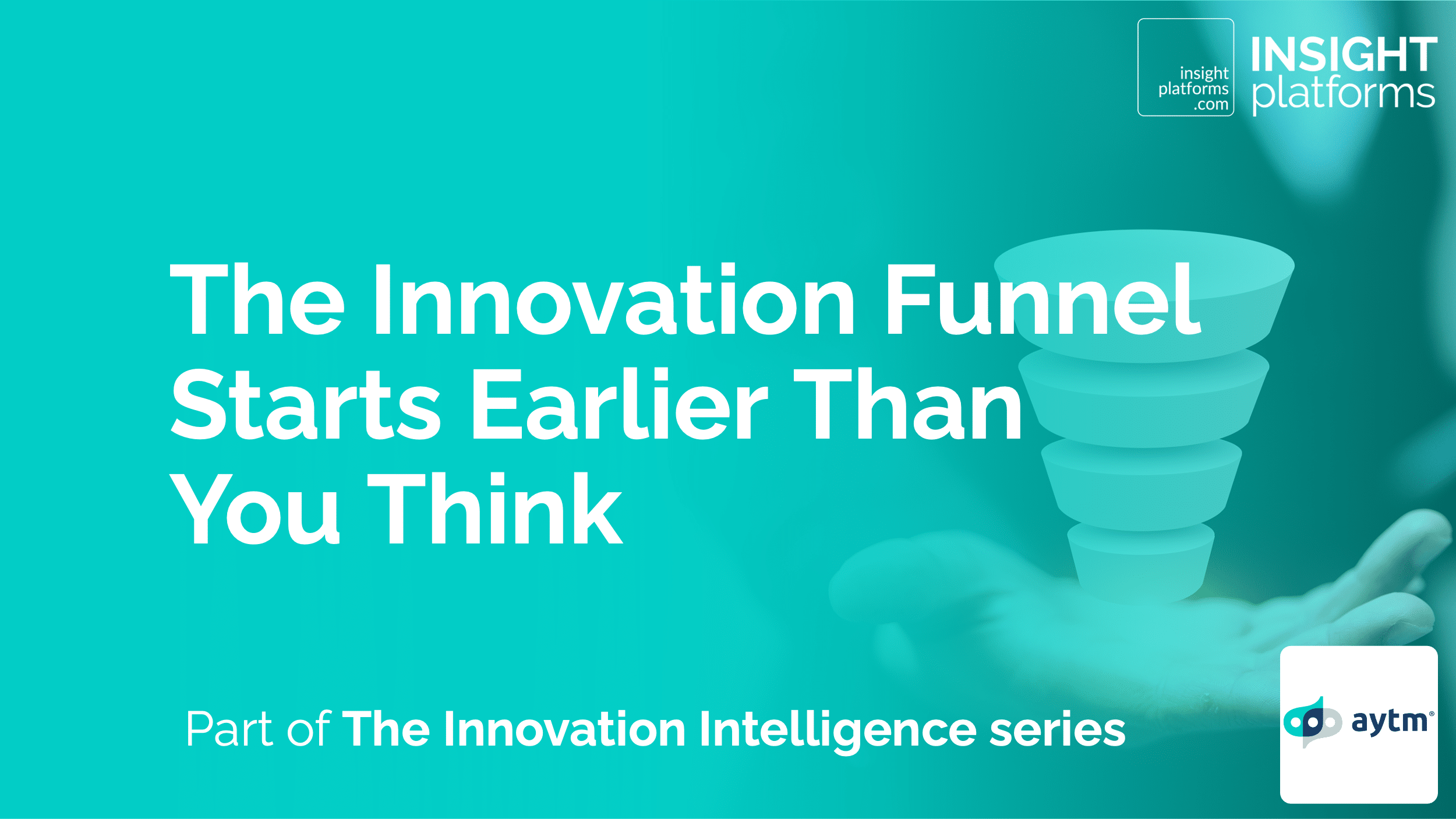
This article is the first in aytm’s Innovation Intelligence series, each of which explores a different stage in the innovation research funnel. These articles summarise elements of the Product Innovation curriculum in the aytm Lighthouse Academy.
Explore the full suite of innovation courses, including the Idea Screening 101 course, here.
The teams that win at innovation get a head start on everyone else, and they get it by putting research to work before they’ve built a single concept. Most product teams already know consumer research matters. The real lever is timing. Many organisations test once they have something polished to show: a developed concept, a prototype or a near-final design. By that point, the research validates a direction that’s already set. The most disciplined innovators start much earlier, and that head start compounds across the entire development cycle.
What The Innovation Funnel Looks Like
The full process moves through six stages: idea generation, idea screening, early-stage concept testing, concept refinement, late-stage concept testing and launch. Most research activity clusters in the later stages. Idea screening sits between raw ideation and structured concept development, and it’s where the biggest opportunity lives.
The decisions made at the screening stage shape everything that follows. Which ideas get developed? Which get resourced? Which get shelved before anyone invests in copy, design or prototyping? A structured screen turns those calls into evidence-based ones, so the ideas you carry forward earn their place on consumer signal rather than hierarchy, familiarity or whoever makes the strongest case in a meeting.
What An Early Screen Makes Possible
Two scenarios make the economics concrete, and they both point in the same direction: screen early, and your budget goes further.
A condiment brand has 20 ideas for new BBQ sauce flavours and can afford to take two to market. Developing full prototypes for all 20, at roughly $5,000 each, runs $100,000. Running an idea screen first and prototyping only the five strongest candidates costs about $30,000. The screen pays for itself many times over, a saving of around $70,000.
A personal care brand brainstorms 40 new product ideas. Building full concepts for all of them (copywriting, design, sometimes external agencies) runs about $1,500 each by industry benchmark, roughly $60,000 and six weeks of work. An idea screen costs about $8,000, and developing only the top six brings the total to around $17,000 while cutting development to two weeks. The net result: about $43,000 saved and four weeks off the timeline.
This is as much a speed advantage as a cost one. Faster decisions about which ideas to pursue mean faster time to market, which in competitive categories can matter as much as the product itself.
What Idea Screening Actually Does
Idea screening hands you a ranked field of your most promising ideas, ready for deeper development. It evaluates a large set of early-stage ideas to identify the strongest candidates. Ideas can stay rough. They need to be clear, consistent, and meaningfully different from one another.
The method best suited to it is MaxDiff (maximum difference scaling). Rather than rating each idea on a scale, where respondents tend to rate everything favourably, MaxDiff asks for trade-offs: shown three to five ideas at a time, respondents pick the most and least appealing. Across 10 to 20 of these screens, the pattern of choices yields a clear rank order and a measure of how strongly each idea is preferred relative to the rest.
aytm uses a hierarchical Bayesian MaxDiff, which estimates preference at the individual-respondent level as well as in aggregate. That produces more stable, more differentiated results, and it’s far easier on respondents than asking them to rate dozens of ideas one at a time. The method can technically handle 7 to 200 ideas, though we recommend capping a single study at 60 to protect data quality, with base sizes scaled to the field:
- 7 to 30 ideas: about 400 respondents
- 31 to 45 ideas: about 500 respondents
- 46 to 60 ideas: about 600 respondents
For six or fewer ideas, a sequential monadic design fits best, where respondents rate each idea one at a time.
The output is a ranked list with statistical confidence behind it. aytm reports three metrics: preference likelihood, utility score and average-based preference likelihood. The most used is preference likelihood, the probability that an idea would be chosen over other ideas in the set. That’s a defensible read on what consumers actually prefer, and by how much, before the expensive work begins.
Where Idea Screening Sits, And What It Delivers
An idea screen delivers prioritisation: a relative ranking of the ideas tested, plus the directional confidence to make the next decision. Its job is to be an early filter, so the rest of the process knows where to aim. Final validation, pricing and positioning guidance and manufacturing feasibility all come later, each with its own stage and method.
The ideas that rank well still move into development, deeper testing, refinement and validation before launch. What screening guarantees is that all of that downstream work points at ideas with demonstrated consumer potential, the ones worth developing rather than the ones that merely sounded good in a brainstorm.
The Structural Shift This Unlocks
Running research this early opens up a more powerful idea of what research is for. Late-stage testing uses research to confirm direction. Screening uses it to set direction, which lowers risk across the entire development cycle.
Teams that screen consistently build something that compounds: a growing body of evidence about what kinds of ideas resonate with their consumers, which sharpens every future round of ideation. Early-stage research becomes an ongoing source of competitive intelligence rather than a one-off project.
Getting Started
The barrier to entry is lower than most teams expect. Ideas can be tested as simple text descriptions, with optional simple visuals. A screen can field in days, and the read is immediate and actionable. aytm’s platform supports the full workflow, from drafting the MaxDiff to interpreting results, with the Skipper assistant available to help structure the study.
Move even one stage earlier, and you’ll reduce waste, compress timelines and raise the odds that the ideas you develop are the ones worth developing. The teams building full concepts before a single consumer has seen the ideas have the most to gain by starting their funnel sooner.
Explore the full Innovation Intelligence curriculum at the aytm Lighthouse Academy, including the Idea Screening 101 course.