
The Rise of the Full-Stack Researcher: How AI Is Breaking Down Qual-Quant Silos
By Discuss
- article
- Insight Communities
- Online Communities
- Online Qualitative
- Remote Qualitative Research
- Qualitative Research
- Mobile Qualitative
- Qual-Quant Hybrid
- Online Focus Groups and Forums
- Group Discussions/Focus Groups
- Depth Interviews
Summarise with AI



I’ve spent my career watching researchers specialise. Brilliant qualitative researchers who have a love and passion for in-depth interviews. Amazing quantitative researchers who know exactly how to design and measure the impact of a price change. The segmentation made sense for decades because mastering these methodologies took years of focused work.
But I think we’ve segmented work too granularly, not just in market research but across the whole world. And through AI, we’re going to be able to blend that.
Learn more by watching or listening to Daniel on the Founders and Leaders Series podcast here:
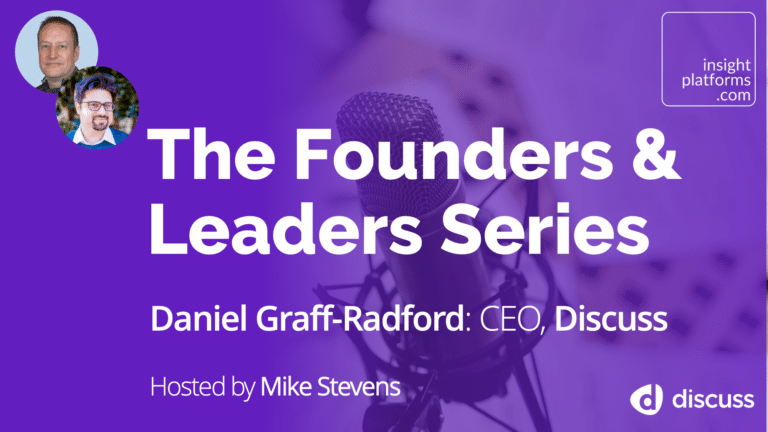
Episode 7: Daniel Graff-Radford, CEO, Discuss
Let me give you a more precise example. With the right thought partner, I think the methodology matters less because working with AI will allow you to bring the right methodology to bear. If you’re a great home builder who is an amazing carpenter and plumber, there’s so much more you can do on that site.
I think these AI tools are going to allow the blending of some of these roles as people build the house of research that they’re trying to help their customers with. You want to be able to be flexible in the methodologies you work with and use the right thought partner AI tool to help decide how to bring the answers forth, to make the decisions as efficiently and expediently as possible.
The Renaissance in Qualitative Research
When we combined forces with Ascribe in 2024, we learned something fascinating by watching our customers. The level of adoption of open-end analytics and the AI tools built inside Ascribe showed us that there was a massive renaissance happening in qualitative research.
Our customers doing quantitative research wanted to know why these answers were coming out the way that they were. People who had really fantastic qualitative interviews wanted to know the level of depth or breadth of those answers that they had. There’s a real opportunity for mixing the modes of qual and quant.
Given what is happening in AI for the speed of insights, this represents a genuine opportunity. When you’re putting companies together, what you’re looking for are those complementary opportunities for customers to get differentiated results by using the tools in combination where they can.
From Trade-offs to Integration
What we’re looking for are ways that researchers can do a massive quantitative study, and maybe they question why. Then, through some in-depth qualitative research on some of those topics, they can have a much faster way to get to a better quality decision with the same-sized budget that they had before. That’s the big ask from our customers that we’re chasing.
This isn’t about replacing expertise. It’s about enabling researchers to apply the right methodology for each question without needing to hand off work to specialists every time they cross the qual-quant boundary. The methodology matters less when you have AI helping you determine which approach fits the problem you’re trying to solve.
The Full-stack Parallel
I was recently talking with a founder of a research technology business who described the emergence of what he calls a ‘full-stack marketer’. Rather than being very finely sliced into specialisms on the marketing side of things, people are able to combine elements of product innovation with campaign development, media strategy, and insight. Because so many of these AI tools can handle some of those parts of the process, the work can be unified under more people without having to split across specialisms.
I think we’ll see some significant role evolution in research as well. The anointed experts in this space are seeing this the same way. When independent groups ask these questions without leading to a specific answer, and you start getting the same sort of result over and over again, I think it’s very validating that people want the depth of true methodologies accelerated through AI enablement.
What This Means in Practice
Over the next two to three years, AI-assisted research is going to be the default. Although cycles will be faster and insights will be more continuous, it won’t change the need to have trust, rigour and human voices at the centre of those decisions.
The idea that you’ll have AI synthetic data talking to AI researchers, providing true insights, is actually not a real thing. I think that is a silly dystopian future. All of our opinions drift, and the reason that market research is such a massive industry is because of that. Understanding that drift in a timely way so that you can make really amazing decisions based on the data is more possible than ever before.
But not if we skip over the reason why, which is the people making those decisions, those people with those opinions that are drifting. You need to have the tools to track that drift and move with it.
Breaking Down the Silos
One of the world’s largest research firms has an amazing group of people thinking really hard about this, and we had a lovely debate about it recently. If there’s going to be a blending of roles, it’s because AI will enable researchers to cross methodological boundaries that previously required entirely different skill sets and training.
This doesn’t mean everyone needs to become an expert in everything. But it does mean that the rigid separation between qual and quant specialists will soften considerably. The researchers who thrive will be those who understand the fundamental principles of both approaches and know how to deploy AI tools to execute them properly.
Lighting the Path Forward
I think one mistake startups make is trying to roll forward a couple of years too quickly. If you don’t light the path for these brilliant researchers who want to reach these answers and get from here to there, you’re not serving them well.
We’re painting a picture of this cross-pollinated set of methodologies and an AI that you’re able to have a conversation with that has unbelievable depth and breadth of understanding of all the research your company’s ever done. We’re not quite there yet. It’s our job to help light the path to get there.
The right way to do this is to build each step in a way that is digestible for the marketing and research departments and for the researchers themselves. They need to be able to use the tools as they sit today, not as we wish they would sit in three years.
The Bottom Line
The full-stack researcher isn’t about replacing specialisation with generalism. It’s about enabling researchers to fluidly move between methodologies as their questions demand, supported by AI tools that help them maintain rigour regardless of which approach they choose.
If you’re a qualitative researcher, this means understanding when your insights would benefit from quantitative validation at scale. If you’re a quantitative researcher, it means recognising when your data patterns demand deeper qualitative exploration of the why behind the what.
The researchers who embrace this flexibility, who use AI as a thought partner to determine the right methodology for each question, are going to make better decisions faster than those who remain locked in methodological silos. And that’s going to matter far more to their organisations than any single technical skill they might possess.
Learn more by watching or listening to Daniel on the Founders and Leaders Series podcast here: