
When Clients Can Chat With the Research Data: A New Delivery Model for Insights Firms
By BT Insights
- article
- Artificial Intelligence
- AI
- Qualitative Research
- Insight Transformation
- Insight Activation
Summarise with AI
AI is no longer just a tool for generating and organising research data; it’s becoming a valuable part of how clients interact with and explore the data itself.
According to Greenbook’s 2025 GRIT report, 67% of research suppliers now build generative AI directly into client deliverables, and some agencies are going a step further. Demoskop recently described giving clients direct access to the same AI platform its own researchers use, so the final report becomes something clients can keep questioning.
At BTInsights, we’re seeing the same pattern across our customers. More and more insights firms are giving their clients direct access to the study data itself, so the client can explore it, question it, and pull from it on their own. What started with a few agencies has become common enough that it’s worth looking at more closely.
Below, we’ll share what we’ve learned: why it’s happening, what it changes for agencies, and the guardrails worth setting before you hand anyone the keys.
The Problem With a Report That Can’t Answer Back
A static deck is a snapshot of what the research team found important at one moment in time. That’s valuable. But it’s also limited.
Two weeks after the readout, a brand manager wonders whether the pricing concerns came mostly from lapsed customers or current ones. A product lead wants every comment about onboarding, not just the three quotes that made slide 22. The data to answer both questions exists. It’s sitting in the transcripts.
In the old model, getting to it meant an email to the agency, a change request, maybe a new line on the invoice, and a wait. Many of those questions simply never got asked.
The truth is, a lot of research value dies right there. The insight was in the data the whole time. The delivery format just couldn’t reach it.
Why More Insights Firms Are Opening Up the Data
AI qualitative data analysis has made direct client access practical in a way it wasn’t a few years ago. Clients no longer need to read 30 transcripts to find an answer. They can ask a question in plain language and get a response grounded in the interviews. When we ask customers why they made the switch, the same reasons keep coming up.
1. Faster delivery
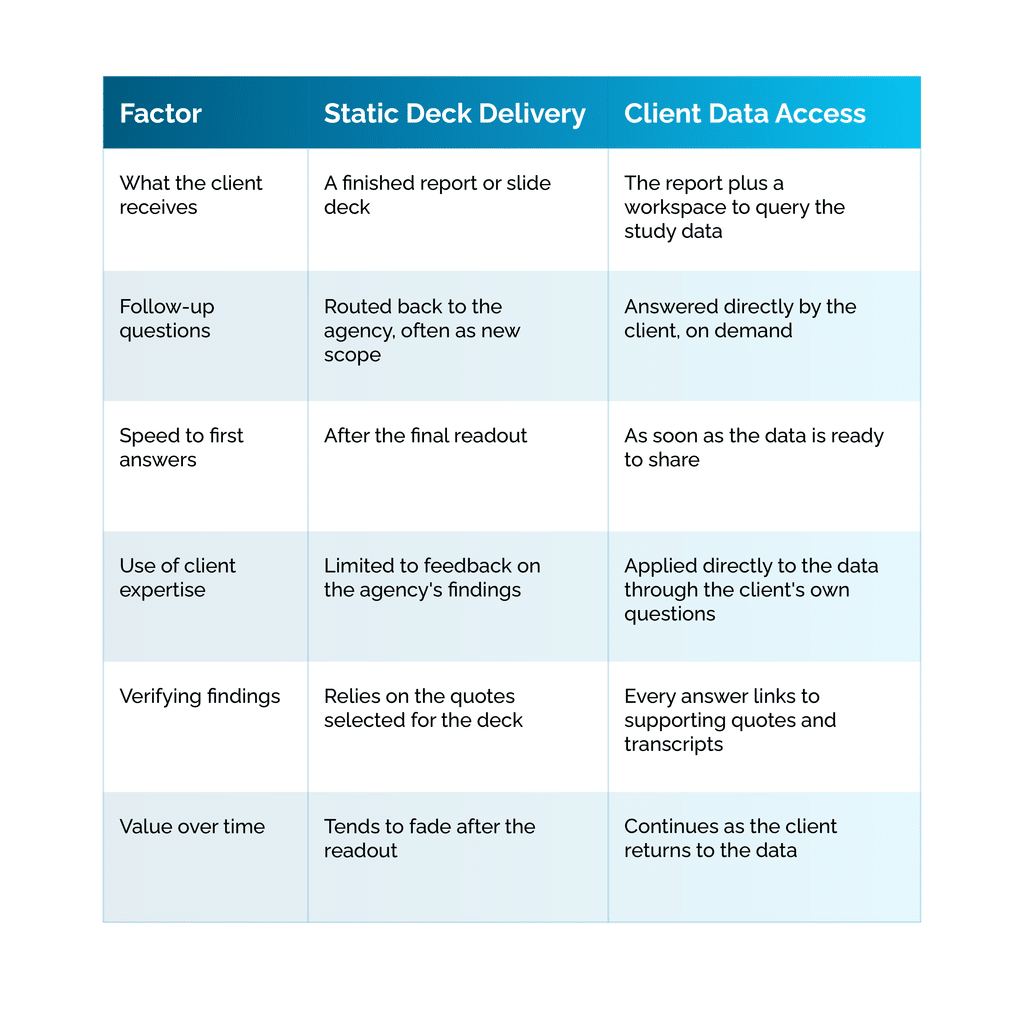
Clients want answers sooner, and research timelines keep getting compressed. When the client can explore the data as soon as it’s ready, they’re not waiting on the final report to start acting on what’s there. The agency still delivers its analysis, but the client isn’t stuck in a holding pattern until then.
2. They know their market better than anyone
This one gets overlooked. The research team knows methodology, but the client often knows the category, the competitors, and the internal politics far better than any outside firm can.
That expertise means they’ll ask questions the agency wouldn’t think to ask. For example, a client in medical devices may immediately spot that a comment about “the old system” refers to a specific competitor product. Giving them access lets that knowledge work directly on the data.
3. Follow-up questions stop being projects
In the static model, every new question carried friction. With direct access, a follow-up is just another query. The client can slice the data by segment, dig into a theme that came up late in the readout, or look for supporting evidence before a leadership meeting.
It’s more flexible. And that flexibility changes how often the research actually gets used.
4. Each study creates more value
When clients return to the data weeks or months later, the study keeps paying off. Findings get reused in planning sessions, cited in product decisions, and revisited when a new question comes up. For the agency, that’s a stronger case for the value of the work and, often, for the next engagement.
What Changes for the Agency
Having said that, opening up the data doesn’t make the agency less important. It changes where the agency adds value.
The analysis and storytelling still matter. Clients still need someone to frame the findings, separate signal from noise, and recommend what to do next. What shifts is that the deck stops being the only product. The agency becomes the team that designed the study, built the analysis, and set up the environment the client now works in.
A few practical questions come up quickly:
Scoping and pricing.
Is ongoing access included in the project fee, or offered as an add-on for a set period?
Onboarding.
Will clients need a short walkthrough on how to ask good questions and how to check the evidence behind an answer?
Support.
Who does the client contact when an answer looks off, and how quickly does the agency respond?
None of these is hard to solve. But they’re much easier to settle before access goes live than after.
4 Guardrails to Set Before Clients Get Access
Sharing research data with clients works well when it’s planned carefully. It creates problems when it isn’t. Across the customer projects we’ve supported, these are the four areas worth settling first.
1. Decide exactly what to share
Not every client needs every feature, and not every transcript belongs in the shared view.
You might want the client to query the interviews but not edit the analysis. You might need to hold back pilot interviews, sessions with recruitment problems, or transcripts that contain sensitive details the client shouldn’t see. Ideally, the tool you use lets you choose both the functionality the client gets and the specific transcripts included in their workspace.
In other words, sharing should be selective by default.
2. Treat data separation as table stakes
One client’s data should never, under any circumstances, be visible to another client. That sounds obvious, but agencies often run studies for competing brands in the same category, sometimes at the same time, and a single permissions mistake can be a serious breach of trust.
Look for clear, org-level separation of data, encryption in transit and at rest, and independent security validation such as a SOC 2 Type II examination. It’s also worth confirming that client data is never used to train AI models.
3. Give clients the same traceability your team has
When your researchers review an AI-generated finding, they check it against the source. Clients should be able to do the same.
Every answer a client gets should link to the supporting quotes, and those quotes should lead back to the original transcript. Without that link, the client has no way to tell a well-grounded answer from a weak one. With it, they can verify findings themselves, which builds far more trust than asking them to take the AI’s word for it.
Keep in mind that this protects the agency too. If a client ever questions a conclusion, the evidence trail is right there.
4. Plan access over time
Decide who on the client side gets access, whether that’s a single research lead or a wider stakeholder group. Set a timeframe that matches the engagement and make sure you can remove access cleanly when the project ends or when someone leaves the client’s team.
It also helps to agree on this in writing up front, so there’s no confusion about whether the data is still available six months later.
Where the Final Deck Fits Now
Final reports will stay part of how research gets delivered, and clients will always need the agency’s story and recommendations. What’s changing is what happens after the readout, and the firms getting the most from this shift treat client access as part of the deliverable, with clear limits on what’s shared, strict separation between clients, and an evidence trail behind every answer.
At BTInsights, we built Deliver into our interview analysis platform with that model in mind. It lets insights firms choose which functionality and which transcripts their end clients can access, and every answer clients receive links back to the supporting quotes, just as it does for the research team. Whichever platform you choose, the goal is the same: a study that keeps answering questions long after the final deck is presented.