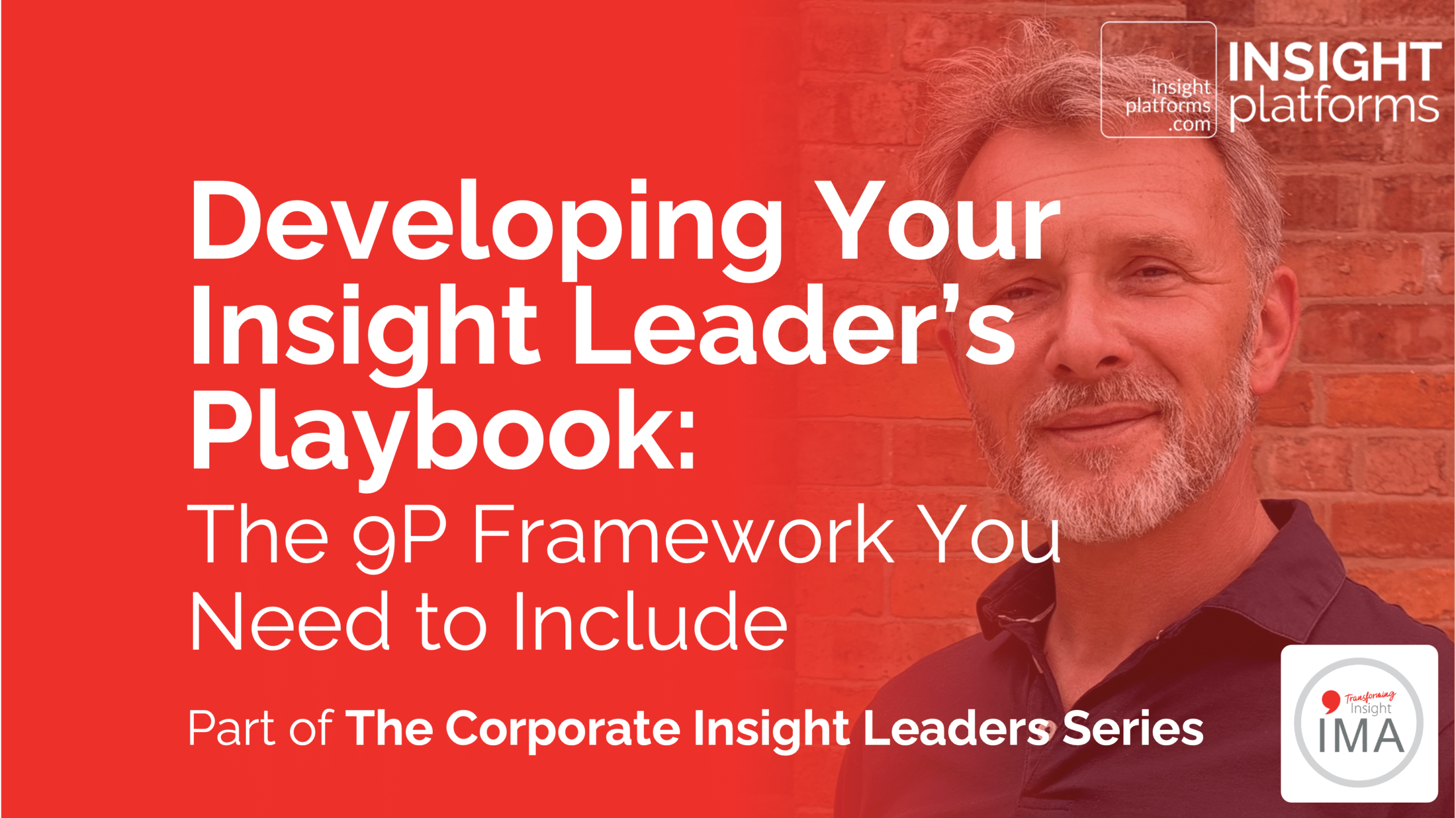
Developing Your Insight Leader’s Playbook: The 9P Framework You Need to Include
By Insight Management Academy
- article
- Insight Transformation
Summarise with AI


James will also facilitate a panel of insights leaders at the Corporate Research & Insights Summit in London in September. If you work in-house in an inside role, check out the rest of the agenda and apply for a free ticket here:
No posts
How do you become a transformational Insight leader?
In the first two articles in our Corporate Insight Leaders series, I looked at the window of opportunity in which we have to shape the future of corporate insight and at the transition we all need to make from being insight producers to insight activists.
However, if you lead a corporate insight team, that still leaves you with the challenge of how you actually bring about these and other changes. The challenge requires transformational insight leadership, something that doesn’t always come naturally to those of us who have grown up as insight managers, market researchers or data analysts.
The good news is that we’re not the only people to face this sort of challenge. There are many parallels in the world of business, particularly in small business.
Michael E. Gerber has written extensively about how the media often refer to owner-managers as ‘entrepreneurs’ when very little of their weekly work is usually entrepreneurial. Gerber makes a distinction between technical, managerial and entrepreneurial leadership, and encourages small business owners to rebalance their time and “work on their businesses rather than in them.”
I adopted the same principle when writing about insight leadership in my first book, Transforming Insight. If business leaders should work on their businesses, not in them, then surely as insight leaders our mindset should be to work on our insight teams, as well as in them.
Why Good Intentions Aren’t Enough
However, while reframing the way we think about our leadership roles can be a critical first step, it doesn’t provide us with a hands-on tool for actually making change happen.
A small business owner will still face the challenge of how to make progress with their business strategy and opportunity-spotting when there are a thousand operational issues to sort out every day. Likewise, insight leaders will still face the challenge of maintaining the inspiration, energy and determination they feel to transform their insight teams when we’re so busy with research requests.
Why Every Insight Leader Needs a Playbook
In his 2021 book, The Business Playbook, Chris Ronzio suggested that the answer was to develop a document that would help business owners to address the entrepreneurial leadership aspect of their roles. This “playbook” would capture key stories that colleagues could share with potential customers, suppliers, recruits and investors, and its existence would help turn fleeting moments of inspiration into a dynamic, tangible record of the key things to be done.
I think this core principle can be inspirational for insight leaders. The simple act of writing something down can be enormously cathartic, as demonstrated by the renewed popularity of journaling. But writing for a purpose, within a framework, allows you to develop a growing asset for your Insight team and your organisation.
It also recognises the reality that however often we succeed in finding brief moments of inspiration, we will inevitably be drawn back into the technical and managerial minutiae of our roles on a daily basis. We might listen to a podcast on Monday morning, dial into a webinar on Wednesday lunchtime or read a short blog on Friday afternoon, but the rest of our week is likely to be taken up with business-as-usual emails and endless meetings.
If we have a simple document to record and crystallise our ideas whenever inspiration strikes, we also have something to return to when it’s time to focus on insight transformation.
Creating an insight leader’s playbook can also provide your team with a structured depository of best practice, a list of practical behaviours that we would like our colleagues to adopt regularly. Aspects of your playbook can also be shared beyond your team: with your boss when selling your vision or asking for resources, with key stakeholders whose support you will need or with suppliers who work with your team.
The 9 Ps Of An Insight Leader’s Playbook
So how should we structure our playbooks? I’d like to suggest that there are nine key aspects for all corporate insight leaders to consider:
- Purpose: why does your insight team exist and what role should it play in your organisation in the future?
- Profile: how will you help other departments see the insight team’s potential in an AI-enabled world, and allow it to play that role?
- People: how should we structure our teams, and develop our colleagues’ mindset and behaviour as we move from insight producers to insight activists?
- Partners: how should you work with internal departments and external suppliers to maximise the insight team’s impact?
- Priorities: what are the key business issues on which you could focus, and how do you decide which will get your resources?
- Products: what is your insight team’s output, how might that change in the future and how could you package it to make it more attractive and easier to consume?
- Process: what platforms, systems and habits need to be in place for the insight team to be effective and to allow you to concentrate on leadership?
- Performance: by which measures will you decide if the insight team has had a successful year and frame your future goals?
- Personal plan: how will you yourself develop the ambition, design and habits to become a more transformational insight leader?
Getting Started
You might well have two questions at this point: “How will I find time to write a playbook?”, and “Where would I start?”.
To answer the first, I’d turn to Lori Kaplan, VP Audience Insights at National Public Radio of America, who described her approach to writing a playbook on stage with me at Quirk’s New York: “It’s easy! I wrote something in each chapter as quickly as I could, and then scheduled an appointment with myself each week to go through the chapters in turn, reflecting on where I’d made progress, and what I wanted to work on in the next week.”
That’s perfect! Don’t overthink it the first time; concentrate on getting some initial ideas on the page, but then develop habits that enable you to deepen and refresh your thinking as needed.
The answer to the second question is that we should always start by looking at the purpose of insight in our organisations. That’s what we’ll explore in the next article in this series.
James will also facilitate a panel of insights leaders at the Corporate Research & Insights Summit in London in September. If you work in-house in an inside role, check out the rest of the agenda and apply for a free ticket here:
No posts