From Insight Producers to Insight Activists: Future Roles for Corporate Insight Professionals
By Insight Management Academy
- article
- Insight Transformation
Summarise with AI


James will also facilitate a panel of insights leaders at the Corporate Research & Insights Summit in London in September. If you work in-house in an inside role, check out the rest of the agenda and apply for a free ticket here:
No posts
What roles will corporate insight professionals play in the future?
In the first article in our Corporate Insight Leaders series, It’s Now or Never: Time for Insight Leaders to Shape the Future of Insight, I said that I thought it was far too early to know. That said, the direction is clear: we need to shift our centre of gravity from being insight producers to insight activists.
But what is an insight activist? And how do we become one?
When the Insight forums first met in 2005, the word “insight” was only just starting to be used in corporate life, and only the most progressive organisations were beginning to bring together the functions responsible for market research, customer analysis, competitor and market intelligence, and trend monitoring. Two decades later, not every organisation has done that yet, but most large companies do gain insights from these disciplines, and the best make efforts to join up learning from across them to solve business problems.
The advent of generative AI won’t change that, but it will, of course, radically transform the way data is sourced, structured, summarised, analysed, and shared. We already have AI-assisted market research, AI-enabled analytics, and AI-powered desk research, and there’ll be much more of that in the coming months and years.
This presents both a fantastic opportunity and a critical challenge for corporate insight professionals. An opportunity, as it should create the chance for us to move upstream and focus on higher-order tasks that bring greater value to our organisations. A challenge, in that if we don’t embark on the journey this year, if not this month or this week, we will have left it too late and could find that our Insight team is downsized, disbanded, or has disappeared.
At the IMA’s Insight forum in November 2025, I set out a new framework called the Insight Professional’s Pyramid to help us navigate that journey.
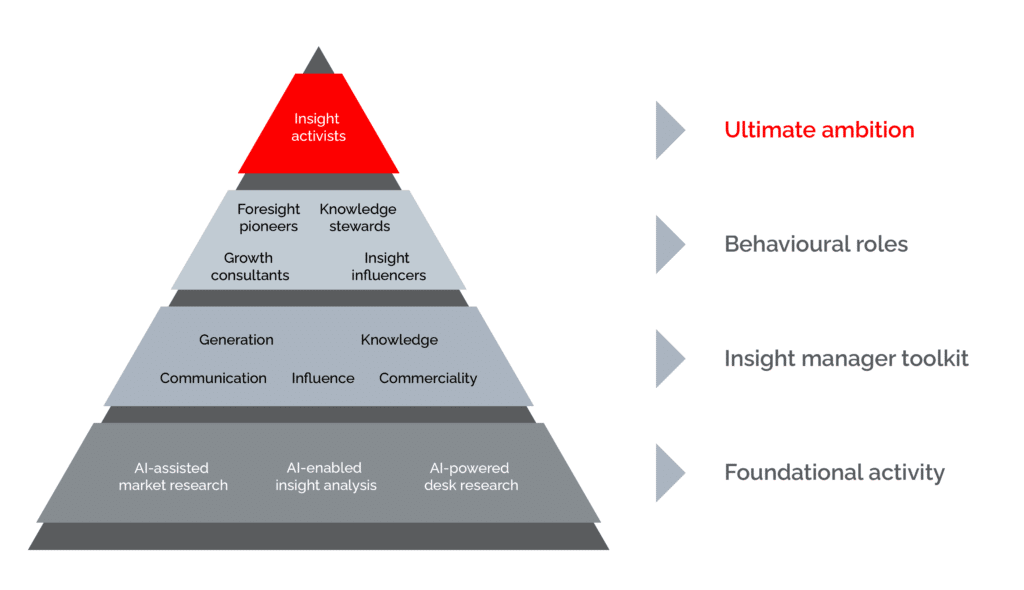
At the base of the pyramid, I placed the foundational insight production activity. I certainly don’t see the need for all human expertise in this layer to disappear overnight, but I do think the number of people who see insight production as their primary focus will decline dramatically.
In the layer above, I have placed the insight manager toolkit, comprising five of the IMA’s best practice territories:
- Joined- up insight generation
- Big picture knowledge development
- Influencing decision-makers
- Communicating insights and accumulated knowledge
- Commercial awareness
Many insight teams have made progress with some aspects of these topics, but too often they have been regarded as the icing on the cake rather than the very essence of insight. Worse still, the IMA’s conversations and benchmarking suggest that progress has stalled for many teams in the last two years, as increased demand and decreased supply have propelled many insight professionals back onto the corporate hamster wheel of data requests.
I have dedicated the next level up to four new behavioural roles we should all embrace. I think it’s too early to know the labels, job descriptions, or reporting lines for future insight teams, but it’s not too early to identify the hats we’ll need to become adept at wearing throughout the week. There may be more than four, of course, but my top picks are:
- Growth consultants: recognising that if we don’t roll up our sleeves and dedicate our working hours to showing our organisation how it can grow sales, retention, basket size, revenue, and market share, we will not be, nor deserve to be, valued by senior decision-makers.
- Foresight pioneers: using every available data source to help our business look around corners, run AI-assisted scenario analysis, and identify key themes that could shape corporate opportunities in the years ahead.
- Knowledge stewards: the more data and intelligence that comes into an organisation, the more important it will be to contextualise it, cross-reference it, and, where appropriate, challenge it. Our focus should not be on what the insight teams know. Rather, it’s what the rest of the organisation knows or thinks it knows, and how we can create an evidence-based, customer-centric culture.
- Insight influencers: making it our mission to share knowledge, co-create solutions, and act as well-networked, trusted advisers. We should develop our personal brand to get us into the room, and our personal presence to impress and be invited back once we’re there.
At the apex of the Insight Professionals’ Pyramid, I see it as our aspiration to be, and be seen as, insight activists. It will be the role to which everything else leads, the very purpose of our corporate existence. Insight has never had any value unless it is used. As such, our mission will be to ensure it is used and monetised more effectively in our organisation than in any equivalent organisation.
A New Perspective
When I first introduced the phrase “insight activist”, I feared a backlash. Still, I stuck with it because whatever we might think of some activists in other walks of life, what they all have in common is that they have formed opinions and seek to become opinion-formers. And that’s as good a way as any of describing the way we should work in the future. We should see data, information, intelligence, and insights not as our end product but as the inspiration from which we will form opinions about what our business should do next, and as the evidence we will draw upon as we collaborate with other departments and seek to influence strategic decisions.
If you lead a corporate insight team, you still have the challenge of how you actually bring about these and other changes. It will require transformational insight leadership, which I’ll look at next in our Corporate Insight Leaders series.
James will also facilitate a panel of insights leaders at the Corporate Research & Insights Summit in London in September. If you work in-house in an inside role, check out the rest of the agenda and apply for a free ticket here:
No posts